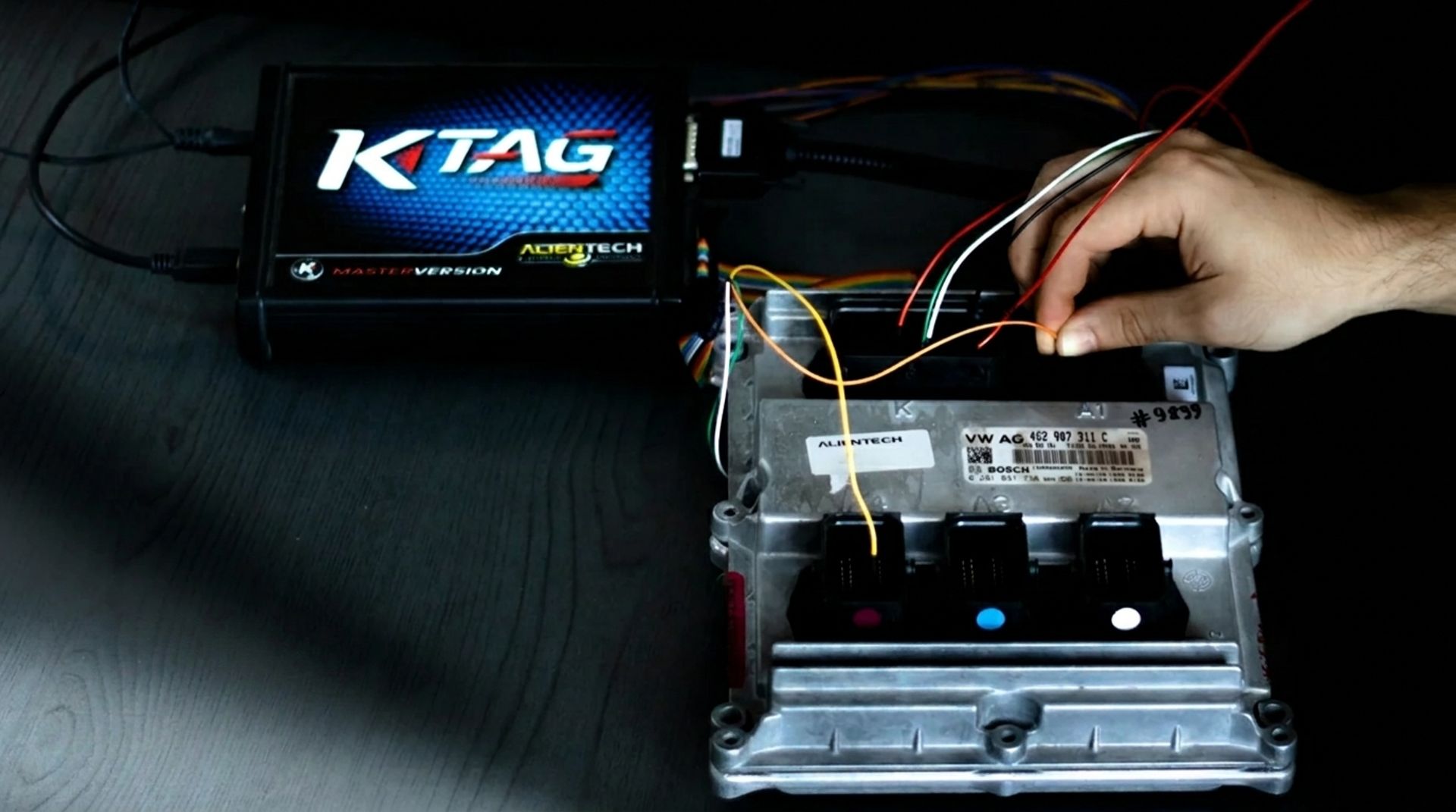
ECU remapping is the process of rewriting the software inside your engine's control computer to release performance that the manufacturer's global calibration left unused. No parts are changed on a Stage 1 remap — the improvement comes entirely from better-optimised software matched to your vehicle and conditions.
What the ECU does
The Engine Control Unit (ECU) is a dedicated computer bolted to your engine or mounted in the engine bay. Thousands of times per second, it reads data from sensors — throttle position, boost pressure, air mass, exhaust gas temperature, crankshaft speed, coolant temperature and many more — and uses that data to make real-time decisions about how the engine runs.
These decisions are not made from simple rules. They are looked up from multi-dimensional calibration tables (maps) stored in the ECU's memory. Each map defines how one parameter should behave across a range of conditions. A single ECU can contain hundreds of these maps governing every aspect of engine behaviour.
Maps, tables and strategies
The most important maps for performance include:
- Torque request maps — how much engine output the ECU targets based on throttle position, gear and driving mode
- Boost pressure maps — the target pressure the turbo should produce at each operating point
- Fuel injection maps — how much fuel is injected and when, relative to piston position
- Ignition timing maps (petrol) — when the spark fires relative to the piston
- Rail pressure maps (diesel) — the fuel system pressure at different loads
- Torque limiters — the maximum output the ECU will allow, regardless of what the engine could produce
- Smoke limiters (diesel) — caps that prevent visible exhaust smoke at high fuelling rates
These maps do not operate independently. They are linked through strategies — higher-level logic that coordinates them. On a modern vehicle, the driver's throttle input generates a torque request, and the ECU calculates what boost, fuelling and timing combination will deliver that torque while staying within all defined limits.
Torque-based engine management
Most modern ECUs (from approximately 2005 onwards) use torque-based management. Instead of the driver directly controlling the throttle plate or fuel injection, the accelerator pedal generates a torque request. The ECU then decides the most efficient combination of air, fuel and timing to deliver that requested torque.
This architecture means remapping a modern ECU is fundamentally different from older vehicles. The calibrator is not simply adding fuel or boost — they are revising the torque request structure and the limits within which the ECU operates. It is a more sophisticated process that requires understanding the entire control strategy, not just individual maps.
Why manufacturers leave headroom
A single engine model may be sold in dozens of countries with different fuel qualities (70–100 RON), altitude ranges (sea level to 3000m+), temperature extremes (−30°C to +50°C), service interval expectations, emissions regulations and noise standards. The factory calibration must work safely and reliably in the worst combination of all of these.
In the UK, with consistent 95–99 RON fuel, moderate altitude, temperate climate and well-maintained vehicles, much of that global safety margin is simply unused. A remap uses the portion appropriate to your actual conditions while maintaining a responsible margin for the factors that remain variable — ambient temperature, fuel batch variation and component ageing.
How the remap process works
A typical remap with us follows these steps:
- Health check — we confirm the vehicle is in good mechanical condition and suitable for tuning
- Read — we connect to the ECU via the OBD port, bench or boot method (depending on the vehicle) and download the original software
- Store — your original file is saved securely so the vehicle can be returned to standard at any time
- Calibrate — we develop a revised file for your specific engine, hardware and goals
- Write — the optimised calibration is loaded into the ECU
- Verify — we road test and, where appropriate, confirm results on the rolling road
OBD, bench and boot access
The method used to read and write ECU software depends on the vehicle. Most cars can be done through the standard OBD diagnostic port under the dashboard — a fast, non-invasive connection. Some newer ECUs with enhanced security require bench access (the ECU is removed and connected on a bench) or boot-mode programming (a direct connection to the ECU's circuit board). All three methods are safe in experienced hands and the ECU is returned to its original location afterwards.
What a remap changes in practice
After a Stage 1 remap, you will typically notice:
- Stronger, more immediate throttle response
- More torque through the mid-range — overtaking and hills become noticeably easier
- Smoother, more linear power delivery without flat spots or turbo lag
- A general sense that the engine has more authority and reserves of power
- Potentially improved fuel economy if you maintain the same driving habits
Always reversible
Because we keep your original file, we can return your ECU to factory software at any time — for a dealer service, a warranty visit, or if you sell the car. The process is non-destructive and fully reversible.
Key takeaways
- The ECU is the computer that controls your engine via software maps and strategies.
- A remap rewrites those maps to optimise performance within the hardware's safe limits.
- Factory software is calibrated for global worst-case conditions — a remap tailors it to your actual use.
- Modern ECUs use torque-based management where a driver torque request cascades through multiple subsystems.
- The process is fully reversible — your original file is always saved.
Frequently asked questions
Will remapping void my manufacturer warranty?
It can affect powertrain warranty claims if the dealer detects modified software. However, it does not automatically cancel your entire warranty. Our work is fully reversible, so the car can be returned to factory software when needed. See our dedicated warranty guide for the full picture.
Can any car be remapped?
The vast majority of modern petrol and diesel vehicles can be remapped, especially turbocharged engines which respond best. Naturally aspirated engines can also benefit, though the gains are more modest. We confirm exactly what is possible for your make and model before any work begins.
Is remapping the same as chipping?
Chipping was the old method of physically replacing a memory chip in the ECU. Modern remapping reads and writes software electronically without removing or replacing any component. The principle is the same — better calibration — but the method is far more sophisticated and reversible.
How long does a remap take?
Typically one to three hours including the health check, software read, calibration, writing and verification. Some vehicles with more complex ECU access requirements take longer.
Does a remap change any physical parts?
No. A Stage 1 remap is software only — no parts are fitted, removed or modified. The improvement comes entirely from optimised ECU calibration matched to your standard hardware.
Want advice for your vehicle?
Speak to a specialist for honest, no-pressure guidance tailored to your car and how you drive.