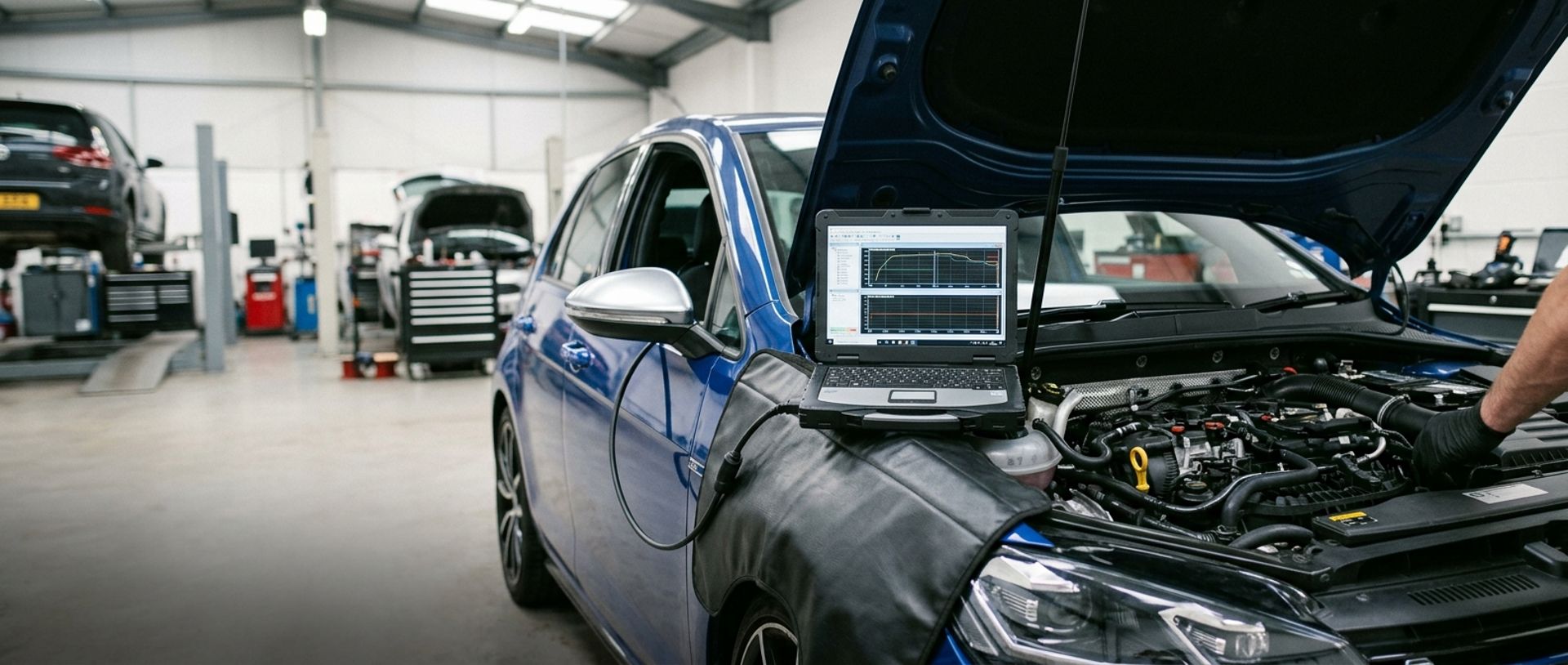
A professionally developed ECU remap is safe for your engine when it is calibrated within the vehicle's mechanical limits and matched to its current condition. The risk is not in remapping itself — it is in how the file is developed, what limits are respected, and whether the vehicle was healthy to begin with.
What makes a calibration safe
Every engine has physical ceilings: maximum cylinder pressure, exhaust gas temperature, turbo shaft speed, injector duty cycle, and gearbox torque capacity. A safe calibration works within all of these simultaneously. It does not chase a single headline number at the expense of another parameter sitting at its limit.
On a modern torque-based ECU, the calibrator adjusts torque request maps, boost targets, fuelling strategies and ignition or injection timing. Each change affects the others, so they must be developed as a coherent set rather than altered in isolation. This is why a properly developed file is fundamentally different from a generic download applied blindly.
Vehicle condition matters
A remap amplifies whatever state the engine is already in. A well-maintained engine with fresh oil, healthy turbo seals, no boost leaks and correctly functioning sensors will respond predictably and reliably. An engine that is already worn, leaking boost or burning oil may not tolerate even a modest increase in load without accelerating an existing problem.
Before tuning, a responsible specialist checks:
- Engine oil level and condition
- Boost system integrity — no leaks or split hoses
- Turbo condition — shaft play, oil consumption
- Cooling system health — thermostat, coolant level, fan operation
- Diagnostic scan for stored or pending fault codes
- Injector balance and fuelling health on diesels
Sensible limits: boost, torque and temperature
A quality calibration sets boost targets that the standard turbo can deliver reliably without over-speeding. It keeps exhaust gas temperatures within the range the manifold and turbine housing are designed for. And critically, it respects the torque capacity of the gearbox and drivetrain — the weakest mechanical link in many modern vehicles.
On turbocharged diesels, the injectors and fuel system have a finite flow capacity. Pushing beyond that to chase a few extra horsepower risks running lean under full load — a condition that raises cylinder temperatures and can damage pistons or head gaskets over time. A conservative, well-developed file leaves margin here rather than running at the mechanical ceiling.
Why maximum gains are not always desirable
The biggest numbers on a dyno graph do not automatically mean the best remap. A file that extracts every last unit of power from standard hardware leaves no safety margin for a hot day, a long motorway pull or a tank of lower-quality fuel. The best calibrations are developed with real-world conditions in mind, not controlled laboratory conditions.
This is why we often recommend a calibration that sits comfortably below the theoretical maximum — it drives brilliantly in all conditions and protects the engine for tens of thousands of miles rather than optimising for a single dyno run.
Engines and gearboxes vary
Not every engine in the same model has the same safe ceiling. Factors like manufacturing tolerances, mileage, service history and even the specific gearbox variant all affect how much additional torque is appropriate. A 2.0 TDI with a six-speed manual may safely accept more torque than the same engine paired with a seven-speed DSG that has a lower torque rating.
This is precisely why vehicle-specific calibration matters. A file developed for one variant cannot be assumed safe on another without verification.
Why poor-quality tuning creates risk
The horror stories — blown turbos, cracked pistons, failed gearboxes — almost always trace back to one of three causes: a generic file not matched to the vehicle, excessive targets beyond what the hardware can sustain, or tuning a vehicle that was not in suitable condition to begin with. None of these are inherent to remapping; they are failures of process and judgement.
Warning signs of a risky approach:
- No pre-tuning health check or diagnostic scan
- No questions about your vehicle's condition, mileage or hardware
- Claims of unusually high gains on standard components
- No explanation of how the file is developed or verified
- No stored copy of your original software
- Unwillingness to discuss limits or trade-offs
How we protect your engine
Every vehicle we tune goes through:
- A full diagnostic health check before any file is loaded
- Calibration developed within documented safe limits for your specific engine, gearbox and hardware
- Road testing and, where appropriate, rolling-road verification
- Your original file stored securely so the vehicle can be returned to factory software at any time
- A lifetime software warranty on the calibration
Safe tuning is a decision, not a guarantee
No responsible specialist can guarantee that nothing will ever go wrong with any engine. What we can guarantee is that the calibration is developed conservatively, verified properly and matched to a vehicle we have confirmed is healthy. That is what separates professional tuning from guesswork.
Key takeaways
- A professionally calibrated remap stays within your engine's mechanical limits and is safe for long-term use.
- Risk comes from poor-quality files, not from the concept of tuning itself.
- Vehicle condition before tuning matters as much as the file quality.
- Not every engine or gearbox responds the same — calibration must account for the weakest link.
- Maximum gains are not always desirable; the best file balances performance with longevity.
Frequently asked questions
Is a Stage 1 remap safe on standard hardware?
Yes, provided the vehicle is in good condition and the file is developed within the standard components' limits. Stage 1 is specifically calibrated not to exceed what factory hardware can reliably handle.
Can remapping damage my gearbox?
It can if the torque exceeds the gearbox's rated capacity. A responsible calibration accounts for the gearbox as part of the overall drivetrain limit, not just the engine. This is especially important on dual-clutch and automated manual transmissions with lower torque ratings.
Is a remapped engine less reliable long-term?
Not when the calibration is conservative and the vehicle is properly maintained. Thousands of remapped vehicles cover hundreds of thousands of miles without issue. Problems arise from over-aggressive files or neglected maintenance, not from well-developed tuning.
Should I get a health check before a remap?
Absolutely. A pre-tuning health check confirms the engine, turbo, cooling system and drivetrain are in suitable condition. It protects you from having an existing problem amplified by additional load.
Why do some tuners promise much bigger gains than others?
Because they are either quoting theoretical maximums with no safety margin, using optimistic measurement methods, or not accounting for real-world conditions like temperature, fuel quality and drivetrain limits. Conservative, honest figures reflect what the vehicle will actually deliver reliably.
Want advice for your vehicle?
Speak to a specialist for honest, no-pressure guidance tailored to your car and how you drive.