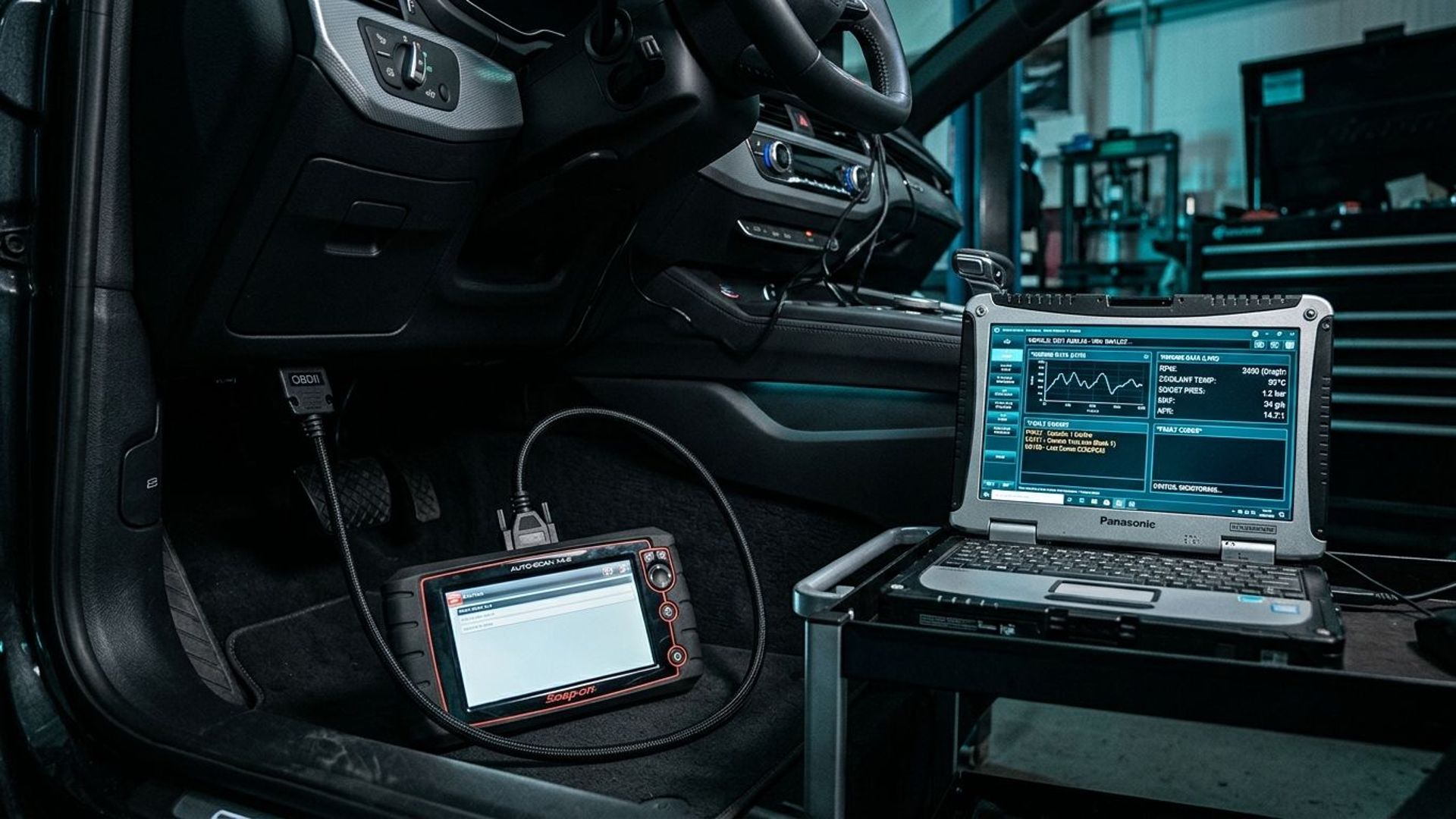
Before loading any calibration, a responsible tuner checks that the vehicle is in suitable condition. This is not a box-ticking exercise — it protects the quality of the tuning outcome, prevents problems that the remap would amplify, and gives you confidence that the vehicle is ready for increased performance demands.
Dashboard warning lights
Any illuminated warning light indicates an active or stored fault that needs investigation. Engine management lights, DPF warnings, glow plug indicators and oil pressure warnings all represent conditions that should be understood and resolved before tuning. A remap loaded on top of an active fault is building on an unstable foundation.
Diagnostic fault-code scan
A full diagnostic scan reads stored and pending fault codes from the ECU and other control modules. This reveals issues that may not have triggered a dashboard light — intermittent sensor faults, historical boost leaks, injector corrections outside normal range, or emissions system problems. It is the single most informative pre-tuning check and should be considered the minimum for any vehicle.
Engine oil and service condition
Engine oil should be at the correct level, within its service interval, and of the correct specification. Degraded oil provides less protection under increased load. Low oil level risks oil starvation under cornering or hard acceleration. If the vehicle is due or overdue a service, completing it before tuning gives the engine the best foundation.
Turbo and boost system
The boost system is where a remap delivers most of its gains on turbocharged vehicles. It must be leak-free and healthy:
- Intercooler hoses and clamps — no splits, no leaks under pressure
- Boost pipes — no cracks or deterioration
- Turbo shaft play — within acceptable limits
- Turbo oil seals — no external oil leakage
- Wastegate or VNT mechanism — operating freely
- Boost control solenoid — functioning correctly
A boost leak means the turbo works harder to achieve the same pressure, and the ECU's boost control strategy cannot deliver consistent targets. On a remapped vehicle with higher boost targets, even a small leak becomes a significant problem.
Intake system
The air filter should be clean and the intake system should be free of leaks downstream of the airflow sensor. Any unmetered air entering after the MAF sensor causes incorrect fuelling calculations — a problem that worsens when the calibration demands more precise fuel delivery at higher loads.
Fuel system
On diesel vehicles in particular, the fuel system's health directly affects tuning potential. Injector balance rates (the correction the ECU applies to equalise cylinder output) should be within normal range. Excessively high corrections indicate injector wear. The fuel filter should be fresh, and the fuel system should be free of air leaks.
DPF condition
A partially loaded or heavily soot-loaded DPF creates back-pressure that affects turbo behaviour, exhaust gas recirculation and regeneration strategy. While a loaded DPF does not prevent remapping, understanding its condition helps set expectations and avoid post-remap regeneration issues. If the DPF is critically loaded, addressing it first is preferable.
EGR and emissions components
A stuck or heavily carboned EGR valve, a failing NOx sensor, or an AdBlue dosing fault all represent potential post-remap problems. They should be identified beforehand so the owner can make informed decisions about repair timing rather than discovering them after the remap is loaded.
Cooling system
The cooling system must be functioning correctly — coolant at the right level and concentration, thermostat operating at the correct temperature, no visible leaks, and the radiator fan cutting in when it should. A marginal cooling system that copes at factory output may overheat at increased power levels, particularly in traffic or during sustained high-load driving.
Clutch condition (manual vehicles)
A clutch that is already showing signs of wear — high bite point, occasional slip under full throttle in a high gear — will not survive increased torque from a remap. Identifying this beforehand allows the owner to plan for a clutch replacement rather than experiencing sudden slip after tuning.
Automatic gearbox behaviour
On automatic and DSG vehicles, the gearbox should be shifting smoothly with no jerks, hesitation or warning lights. Some automatic gearboxes have adaptive strategies that may need a reset after remapping. Identifying existing gearbox concerns beforehand avoids confusion about whether the remap caused them.
Existing modifications
If the vehicle already has modifications — intake, exhaust, intercooler, tuning box, previous remap — the tuner needs to know. The calibration must be matched to what is actually fitted, not what a standard vehicle would have. A previous remap also means the flash counter has already incremented.
Vehicle-specific known issues
Experienced tuners know the common weaknesses of specific platforms — a timing chain tensioner that fails on one engine, an oil pump that is marginal on another, a turbo actuator that sticks on a third. These platform-specific checks are part of the knowledge a specialist brings beyond the generic inspection.
Not every car needs every check
A well-maintained, low-mileage vehicle with full service history and no symptoms may only need a diagnostic scan and a quick visual inspection. A high-mileage vehicle with gaps in its history warrants a more thorough assessment. The scope of the pre-tuning check should match the vehicle's age, mileage and condition — it is not a rigid universal checklist.
Prevention is cheaper than repair
Everything we check before tuning is something that could cause a problem afterwards if left unaddressed. Twenty minutes of inspection can save weeks of diagnosis later. We include a health check with every remap because the outcome is better for everyone when the vehicle is ready for it.
Key takeaways
- A pre-tuning inspection protects the outcome of the remap and the health of the vehicle.
- Not every vehicle requires every check — the scope depends on the car, its mileage and its history.
- The diagnostic fault-code scan is the minimum starting point for any vehicle.
- Boost system integrity, oil condition, turbo health and cooling are the most critical areas.
- If issues are found, addressing them first gives a better tuning outcome than working around them.
Frequently asked questions
Do you check my car before remapping?
Yes. We perform a health check on every vehicle before loading a calibration. The scope depends on the vehicle — a full diagnostic scan is the minimum, with more thorough inspection on higher-mileage or unknown-history vehicles.
What happens if you find a problem?
We tell you what we found, explain its significance, and advise whether it should be addressed before tuning or whether it is acceptable to proceed. The decision is yours, but we will always give an honest recommendation.
Can I do any checks myself before bringing the car in?
You can check oil level and condition, look for obvious boost leaks or split hoses, ensure the cooling system is full, and note any warning lights or unusual behaviour. These basic observations help, but the diagnostic scan and professional assessment is what catches hidden issues.
Does the health check add time to the appointment?
It is included in the normal appointment time. For most vehicles it takes 15–30 minutes as part of the initial assessment before we read the ECU. It is not an additional visit.
What if my car fails the check but I still want a remap?
We will explain what we found and the risks of proceeding without addressing it. In some cases we may decline to tune until the issue is resolved — particularly if it risks engine damage or a poor outcome. In others, we may proceed with a more conservative calibration that does not stress the marginal component.
Want advice for your vehicle?
Speak to a specialist for honest, no-pressure guidance tailored to your car and how you drive.