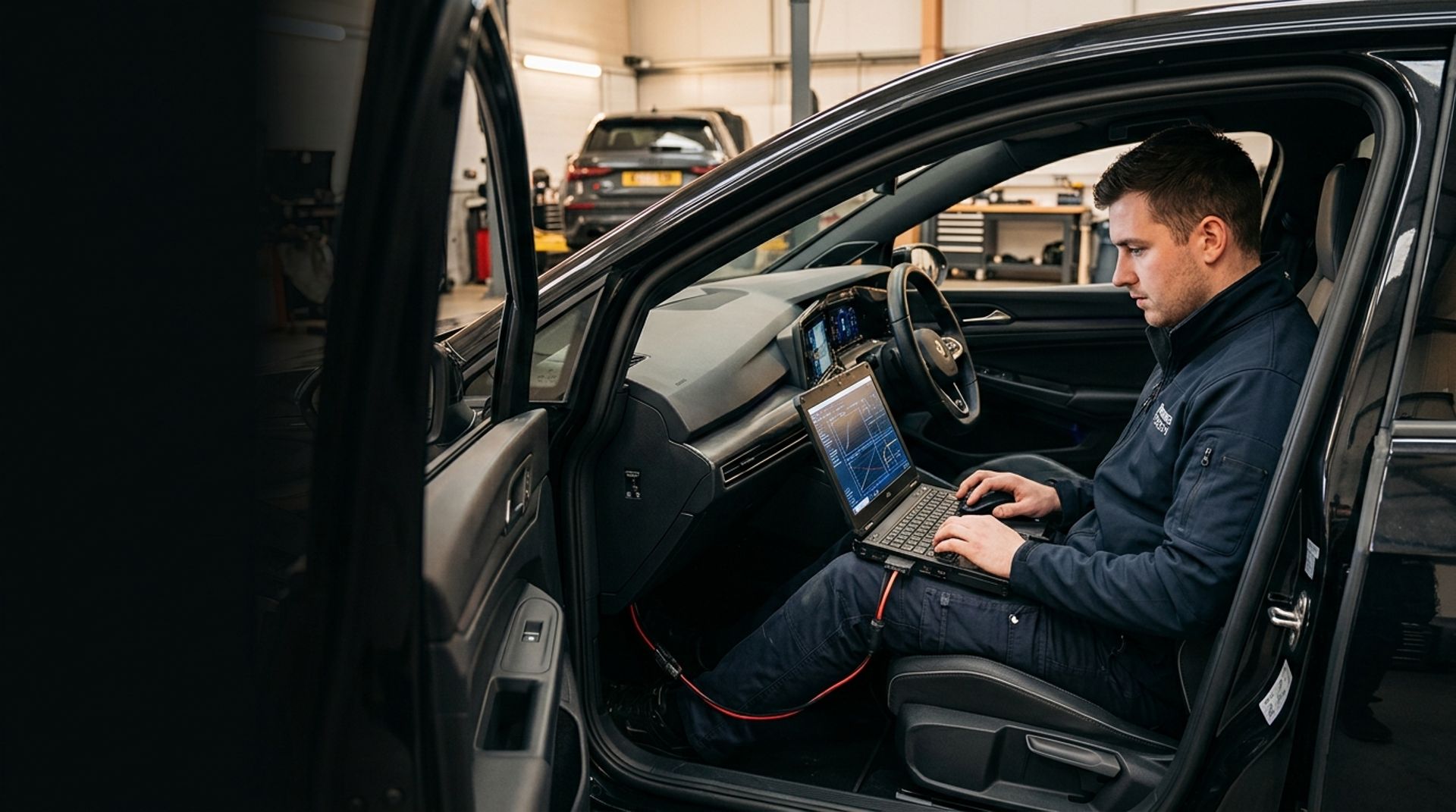
The single biggest factor in how good your remap turns out is who does it. Two tuners using the same hardware on the same car can produce vastly different results — one a reliable, well-calibrated improvement, the other an over-aggressive file that compromises long-term reliability. Here is how to tell the difference before you hand over your keys.
Experience and specialisation
Tuning is a skill that takes years to develop. A specialist with deep experience on your vehicle platform will understand its specific characteristics, common weaknesses, gearbox limitations and ECU quirks. Ask how long they have been tuning, what platforms they specialise in, and whether they have experience with your specific engine variant.
A tuner who remaps everything from a Fiat 500 to an HGV may be perfectly capable, but depth of platform knowledge is what separates a file that drives well from one that drives brilliantly on your specific vehicle.
Software quality: custom vs generic
This is the most important distinction in the tuning industry. Some companies develop calibrations in-house for each vehicle they work on. Others download pre-made files from a bulk supplier, load them without modification, and hope the generic calibration suits the specific car. Both are technically ‘remaps’, but the quality difference is enormous.
Questions that reveal software quality:
- Do you develop the file yourself, or source it from a supplier?
- Is the file matched to my specific ECU hardware and software version?
- How do you verify the calibration after loading it?
- Can you adjust the file if I have feedback about how it drives?
- What rolling-road or data-logging equipment do you use?
Diagnostics and pre-tuning checks
A responsible specialist checks the vehicle before loading any file. A diagnostic scan for fault codes, a boost leak check, basic mechanical inspection and sometimes a baseline data log are all signs of a tuner who cares about the outcome rather than just getting the job done quickly.
If a tuner wants to load a file within minutes of seeing your car for the first time, with no questions about its condition or history, that should raise concerns. A pre-tuning check protects both you and the tuner from discovering problems after the remap is loaded.
Realistic claims
Be cautious of tuners who quote unusually high gains relative to the industry norm for your vehicle. If one company claims 50% more power from a Stage 1 remap while everyone else quotes 25–30%, either their measurement method is different, their calibration is more aggressive, or their claims are overstated.
Ask how gains are measured and verified. Are they rolling-road tested? Are correction factors applied? A tuner confident in their results will happily explain their methodology. One relying on inflated claims will deflect.
Original-file backup and reversibility
Any reputable tuner stores a copy of your original ECU software before making changes. This is non-negotiable. Without it, the vehicle cannot be returned to factory specification for warranty visits, dealer services or resale. Ask specifically: do you keep my original file, how long for, and can you return the car to standard at any time?
Tuning tools and verification
Professional tuning requires professional tools. ECU reading and writing equipment, rolling-road or portable dyno access for verification, wideband exhaust gas analysis, and data-logging capability are all indicators of a well-equipped specialist. These tools allow the tuner to verify that the file performs as intended, not just assume it does.
Not every remap requires a rolling-road session, but the tuner should have access to one and use it where appropriate — particularly on higher-power builds or vehicles where they have less experience.
Support and aftercare
Tuning is not a one-touch service. Vehicles occasionally need file adjustments after the initial map — perhaps for a different fuel, a change in hardware, or driver feedback about a specific aspect of the delivery. A good tuner offers ongoing support, file updates when needed, and stands behind their work with a meaningful warranty.
Ask what happens if you are not happy with the result, if you want a small adjustment to the calibration, or if you fit additional hardware later. The answer reveals how the tuner views the customer relationship — as a one-off transaction or an ongoing partnership.
Transparency and honesty
A trustworthy specialist explains what they are doing and why. They tell you the trade-offs, not just the benefits. They discuss reliability, not just power. They recommend against tuning when a vehicle is not suitable, rather than taking the money regardless.
When a tuner should refuse a job
This is perhaps the strongest indicator of integrity. A specialist who turns away work when a vehicle is not in suitable condition — worn turbo, failing injectors, existing mechanical problems — is one who puts long-term outcomes above short-term revenue. If a tuner will remap anything regardless of condition, their priority is volume, not quality.
A good tuner should say no when:
- The vehicle has existing mechanical problems that tuning would worsen
- The customer's expectations are unrealistic for the hardware fitted
- The requested level of tune exceeds what the drivetrain can safely handle
- The vehicle has not been properly maintained and is not in suitable condition
- The customer refuses a recommended health check before tuning
The Elite Remaps standard
With over 20 years of experience, in-house custom calibration, rolling-road verification and a lifetime software warranty on every remap, we built our reputation on doing the job properly. We are happy to answer any question about our process, our tools or our approach — transparency is how we earn trust.
Key takeaways
- Who does your remap matters more than anything else — the same hardware produces very different results depending on calibration quality.
- A genuine specialist develops the file for your exact vehicle, not downloads a generic map from a supplier.
- Insist on a pre-tuning health check, a stored original file and a meaningful warranty.
- Be cautious of anyone promising the biggest numbers with no questions about your car.
- A good tuner should be willing to refuse a job when the vehicle is not suitable.
Frequently asked questions
How do I know a remapping specialist is any good?
Look for custom-developed files rather than generic downloads, rolling-road verification capability, a stored copy of your original software, honest and realistic gain claims, transparent methodology, and genuine customer reviews. A good specialist explains what they do and why.
Is the cheapest remap ever worth it?
Rarely. The lowest prices almost always mean generic, unverified files loaded without vehicle-specific calibration, health checks or aftercare. A properly developed remap costs more but protects your engine and delivers verified results.
What warranty should a remapping specialist offer?
At minimum, a warranty on the software itself — meaning free file correction if there is a fault with the calibration. Better specialists offer a lifetime software warranty covering re-flashes, updates and adjustments for as long as you own the vehicle.
Should I choose a mobile tuner or a workshop?
Both can be excellent. What matters is the quality of the calibration, not the location. However, a workshop with rolling-road access has an advantage for verification, particularly on higher-power builds. For a straightforward Stage 1, a well-equipped mobile tuner can deliver identical results.
What if I am not happy with the result?
A reputable specialist will offer file adjustments based on your feedback, or return the car to standard if you prefer. This is part of the service. If a tuner refuses to make adjustments or discuss concerns, that tells you something about their customer commitment.
Want advice for your vehicle?
Speak to a specialist for honest, no-pressure guidance tailored to your car and how you drive.