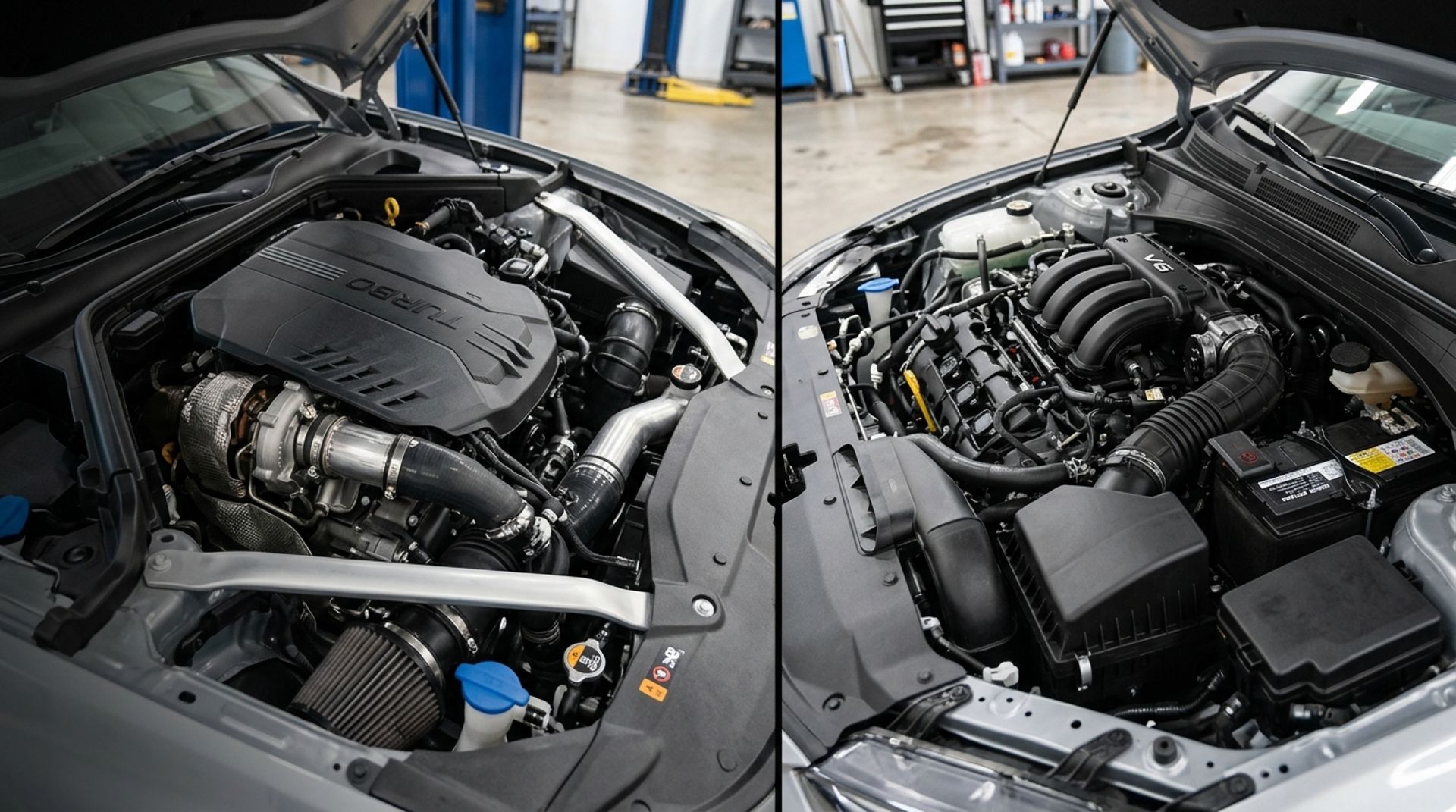
Whether your engine has a turbocharger is the single most important factor in how much a remap can deliver. Turbocharged engines routinely show gains of 20–40% in torque and power. Naturally aspirated engines typically gain 5–15%. The reason is fundamental to how each engine type makes power.
Why turbocharged engines respond so strongly
A turbocharger forces additional air into the engine, and the amount of boost it produces is controlled by software. The factory sets conservative boost targets to accommodate global conditions, and those targets are a direct limit on how much power the engine makes. Raising them within the turbo's safe operating range immediately releases significant extra torque and power.
Beyond boost alone, the fuelling system on a turbocharged engine is designed to deliver more fuel than the factory calibration uses at most operating points. The injectors, fuel pump and rail pressure system have headroom built in for durability and altitude compensation. A remap uses that headroom to match the increased airflow from higher boost, creating a proportional increase in output.
The combination of increased boost, optimised fuelling and revised torque limits produces the dramatic improvements that make turbo remaps so popular. The hardware is already capable — the factory software simply does not ask it to deliver its full potential.
What turbo engines gain in practice
- Strong mid-range and low-end torque increase — the most noticeable everyday improvement
- Meaningful peak power gain — typically 20–40% depending on engine and existing headroom
- Sharper, more immediate boost response with reduced turbo lag
- More confident overtaking, towing and loaded driving
- Smoother power delivery across the usable rev range
Why naturally aspirated engines gain less
A naturally aspirated engine has no forced induction — it relies on atmospheric pressure and its own breathing efficiency to fill the cylinders. The amount of air it can ingest is limited by port design, valve timing, intake runner length and throttle body size. No software change can increase these physical constraints.
What a remap can do on a naturally aspirated engine is optimise ignition timing, variable valve timing (where fitted), throttle response and fuelling within the air the engine already breathes. The gains are real but modest in absolute terms compared with what a turbo engine achieves.
What naturally aspirated engines gain in practice
- Sharper, more responsive throttle feel — less electronic delay and filtering
- Smoother, more linear power delivery through the rev range
- Small increase in peak power — typically 5–15% depending on engine
- Improved variable valve timing utilisation where the system allows adjustment
- Better driving experience overall, even if the absolute gains are modest
Boost control and why it matters
On a turbocharged engine, the ECU controls boost via a wastegate or variable-geometry vane mechanism. The factory sets a target boost curve that the turbo system delivers. A remap raises this curve within what the turbo can sustain reliably — considering compressor efficiency, shaft speed, exhaust back-pressure and bearing oil temperature.
The key constraint is the turbo's compressor map. Every turbo has an efficiency range beyond which it over-speeds, surges or heats the intake charge excessively. A responsible calibration stays within this range and does not push the turbo beyond its reliable operating envelope.
Torque limits and drivetrain considerations
On turbocharged vehicles, the gearbox torque rating is often the first hard limit reached. A Stage 1 remap that respects gearbox limits will deliver less peak torque than the engine could theoretically produce. This is not conservative tuning for the sake of it — it is protecting the drivetrain from accelerated wear or sudden failure.
On naturally aspirated vehicles, gearbox limits are rarely a concern because the engine does not produce enough torque to challenge them even after remapping.
When exceptions exist
Not every turbocharged engine has vast untapped potential. Some factory calibrations already run the turbo near its efficiency limit — particularly on small-displacement, high-output engines where the turbo is sized for response rather than headroom. On these vehicles, Stage 1 gains may be more modest than expected, and meaningful additional performance requires Stage 2 hardware.
Equally, some naturally aspirated engines with sophisticated variable valve timing systems (Honda VTEC, BMW Valvetronic, Toyota VVT-i) have more calibration scope than simpler designs. Expectations should always be set per-vehicle, not per-category.
Honest expectations first
We will always tell you realistically what your specific engine can gain before you commit. If the headroom is modest, we will say so. If a turbo is already near its limit, we will explain what Stage 2 hardware would unlock rather than over-promising on Stage 1.
Key takeaways
- Turbocharged engines gain the most because boost pressure and fuelling are software-controlled with built-in headroom.
- Naturally aspirated engines are limited by volumetric efficiency — they can only burn what they can physically breathe.
- The difference between turbo and NA gains is typically two to four times in percentage terms.
- Both engine types benefit from improved throttle response and smoother delivery.
- Exceptions exist — some factory turbos are already running near their limit and gain less than expected.
Frequently asked questions
Is it worth remapping a naturally aspirated car?
It can be — for sharper throttle response, smoother delivery and a modest power increase. But the gains are much smaller than a turbocharged engine. We will give you an honest view for your specific vehicle before you commit.
Why do turbo engines gain so much more?
Because boost pressure is software-controlled with built-in headroom. Raising boost targets within the turbo's safe range directly increases the air available for combustion, which proportionally increases power and torque. Naturally aspirated engines have no equivalent mechanism.
Can a small turbo engine still gain a lot?
Usually yes, but it depends on how hard the factory already pushes the turbo. Small turbos sized for response rather than outright flow may have less headroom than larger units. We assess this per-vehicle before making promises.
Will remapping my NA engine make it feel like a turbo car?
No. Remapping improves what the engine already does — it does not change its fundamental character. A naturally aspirated engine will always be more progressive and linear than a turbocharged one. The improvement is in responsiveness and refinement, not in adding a forced-induction-style power delivery.
Does a twin-turbo engine gain twice as much as a single turbo?
Not necessarily. The gains depend on the available headroom in the calibration, not the number of turbos. A twin-turbo system with conservative factory targets may gain a lot, but one that is already well-utilised may not. It is vehicle-specific, not a simple multiplier.
Want advice for your vehicle?
Speak to a specialist for honest, no-pressure guidance tailored to your car and how you drive.