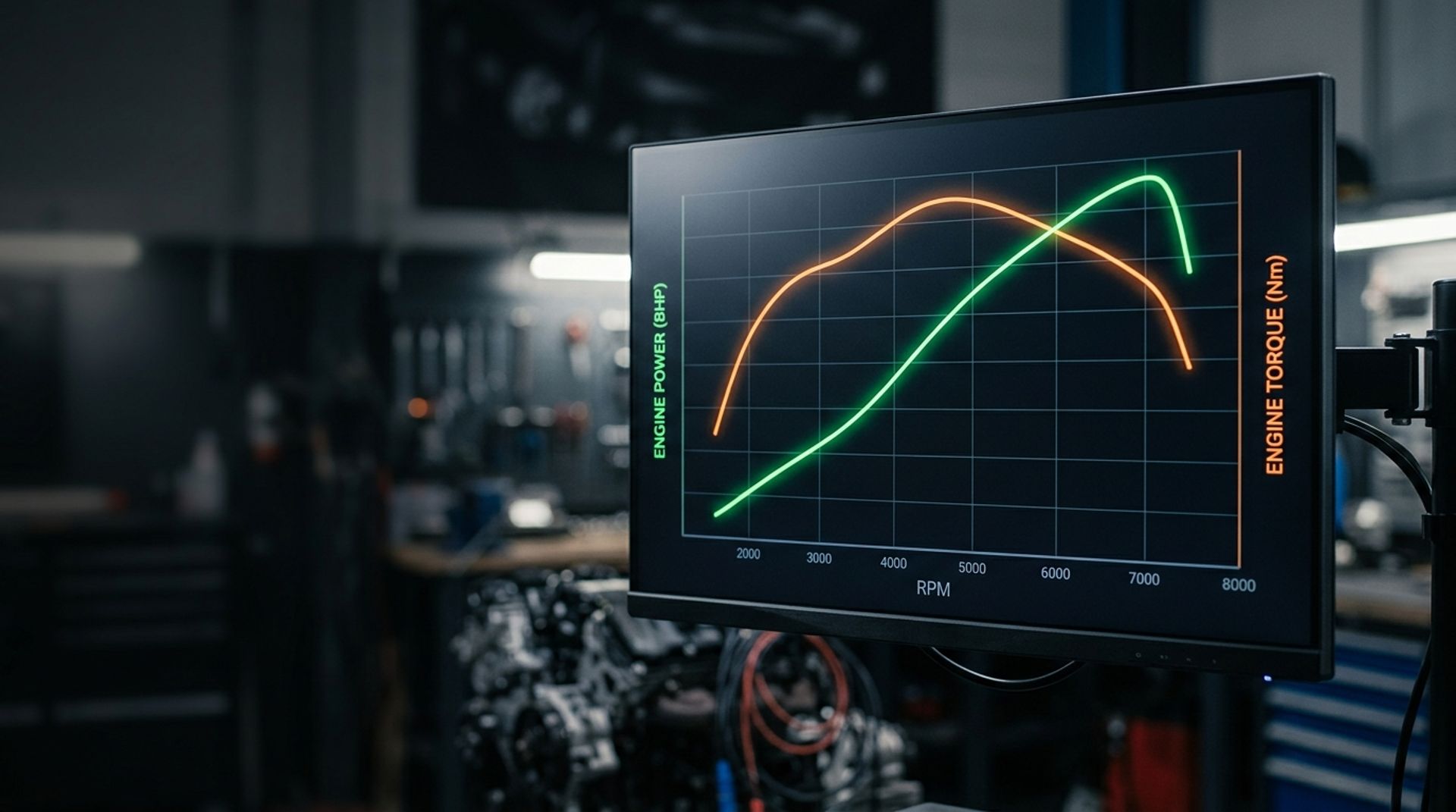
Every remap is accompanied by power and torque figures, but unless you understand what those numbers mean in practice, they are just marketing. Here is what actually changes after a remap and why it makes your car feel different to drive.
Torque: the pulling force you feel
Torque is rotational force — the twisting effort the engine applies to the crankshaft. In driving terms, it is what gets the car moving from rest, what pulls it up a hill, what gives you confidence when overtaking, and what makes a loaded vehicle feel effortless rather than strained.
Diesel engines produce their peak torque low in the rev range, which is why a remapped diesel feels so much stronger in everyday use. The extra torque arrives exactly where you spend most of your time — at moderate revs during normal driving. You press the throttle less to maintain speed, need fewer gear changes, and the car simply feels like it has a larger engine.
Power: torque sustained at speed
Power (measured in horsepower, bhp or PS) is mathematically derived from torque and engine speed. It describes how much work the engine can do per unit of time. In practical terms, power determines how quickly the car can accelerate at higher speeds and how its performance sustains as velocity builds.
A car with high torque but low power feels strong at low speed but runs out of breath at higher revs. A car with high power but low torque feels flat at low speed but comes alive at the top end. A well-calibrated remap improves both — more torque where you use it most, and more power to sustain that performance as speed builds.
Why manufacturers leave performance on the table
Factory software is calibrated to cover every market worldwide — from Norwegian winters to Middle Eastern summers, from high-altitude roads to sea-level motorways, from premium fuel to the lowest-quality petrol available globally. It must also meet strict noise, emissions and fuel consumption targets across all test cycles.
To achieve all of this simultaneously, manufacturers build in a safety margin. The engine is mechanically capable of producing more, but the software limits it. A remap uses that margin — tailored to UK conditions, UK fuel quality and the specific vehicle's hardware — to release performance that was always mechanically available but software-limited.
What limits the gains
The gains a remap can safely deliver are determined by whichever component reaches its limit first. On some vehicles that is the turbo, on others it is the gearbox torque rating, and on others it is the fuelling system's flow capacity. A responsible calibration identifies this limiting factor and develops the file to sit comfortably within it.
Common limiting factors on standard hardware:
- Turbo compressor efficiency and shaft speed
- Gearbox or clutch pack torque rating
- Injector flow capacity and rail pressure
- Exhaust gas temperature thresholds
- Intercooler heat rejection capacity
- Knock sensitivity on petrol engines
Why percentage gains can mislead
A 30% power gain sounds impressive, but on a 100 bhp naturally aspirated car that is 30 bhp — a modest absolute increase you will barely notice on the road. The same 30% on a 200 bhp turbocharged car is 60 bhp — a transformation in how it drives. Always consider the absolute figures and how they translate into real-world acceleration, not just the percentage.
Similarly, comparing quoted gains between tuners is unreliable unless you know how they were measured. Rolling-road figures depend on correction factors, ambient temperature, the dyno itself and how the run was conducted. Two tuners quoting different numbers may have produced an identical file — the measurement method is what differs, not the outcome.
How gains translate to real driving
The real test of a remap is not the peak number on a dyno graph but how the car feels on the road:
- More torque at low revs = less throttle needed to maintain speed, fewer gear changes, easier towing
- Stronger mid-range = more confident overtaking without dropping multiple gears
- Higher peak power = better sustained acceleration at motorway speeds
- Smoother delivery = less lag, more progressive response, less surging
Proven, not promised
Where appropriate we verify gains on the rolling road, so the figures we quote reflect what your car actually produces — not theoretical estimates. We will always give you honest expectations for your specific vehicle before you commit.
Key takeaways
- Torque is the force that gets you moving and pulls you up hills — it is what you feel most in daily driving.
- Power is how quickly torque can be sustained as speed builds — it determines acceleration and overtaking ability.
- A good remap improves both together, not one at the expense of the other.
- Factory detuning leaves a margin that a remap can safely use without exceeding hardware limits.
- Percentage gains can mislead — always consider the absolute numbers and how they translate to real-world feel.
Frequently asked questions
Which matters more for everyday driving, power or torque?
Torque. It is the pulling force you feel at moderate revs during normal driving — overtaking, hills, towing and general responsiveness. Power matters more for outright speed and sustained high-speed acceleration.
Are the quoted gains guaranteed on my car?
Gains vary by individual vehicle condition, mileage, fuel and ambient conditions. We give honest expectations based on your specific engine and verify results on the rolling road where appropriate. We do not guarantee exact numbers because too many variables are outside our control.
Why does my car feel so much faster when the numbers seem modest?
Because the improvement happens where you actually drive. An extra 80 Nm of torque at 2000 rpm transforms everyday drivability far more than an extra 30 bhp at 5000 rpm that you rarely use. The shape of the torque curve matters as much as the peak figure.
Can a remap add power without adding torque?
In practice, they go together. Power is derived from torque and engine speed, so increasing torque at any given RPM automatically increases power at that point. A properly developed file improves both across the usable rev range.
Why do different tuners quote different gains for the same engine?
Measurement methods, correction factors, ambient conditions and how conservatively the file is calibrated all affect quoted figures. Two files with identical real-world performance can show different numbers on different dynos. Focus on the driving experience and the tuner's methodology, not headline figures alone.
Want advice for your vehicle?
Speak to a specialist for honest, no-pressure guidance tailored to your car and how you drive.